AI & Machine Learning in Marketing | Smarter Business Growth
 Written by Brendan Byrne
| Monday, July 27, 2026
Written by Brendan Byrne
| Monday, July 27, 2026
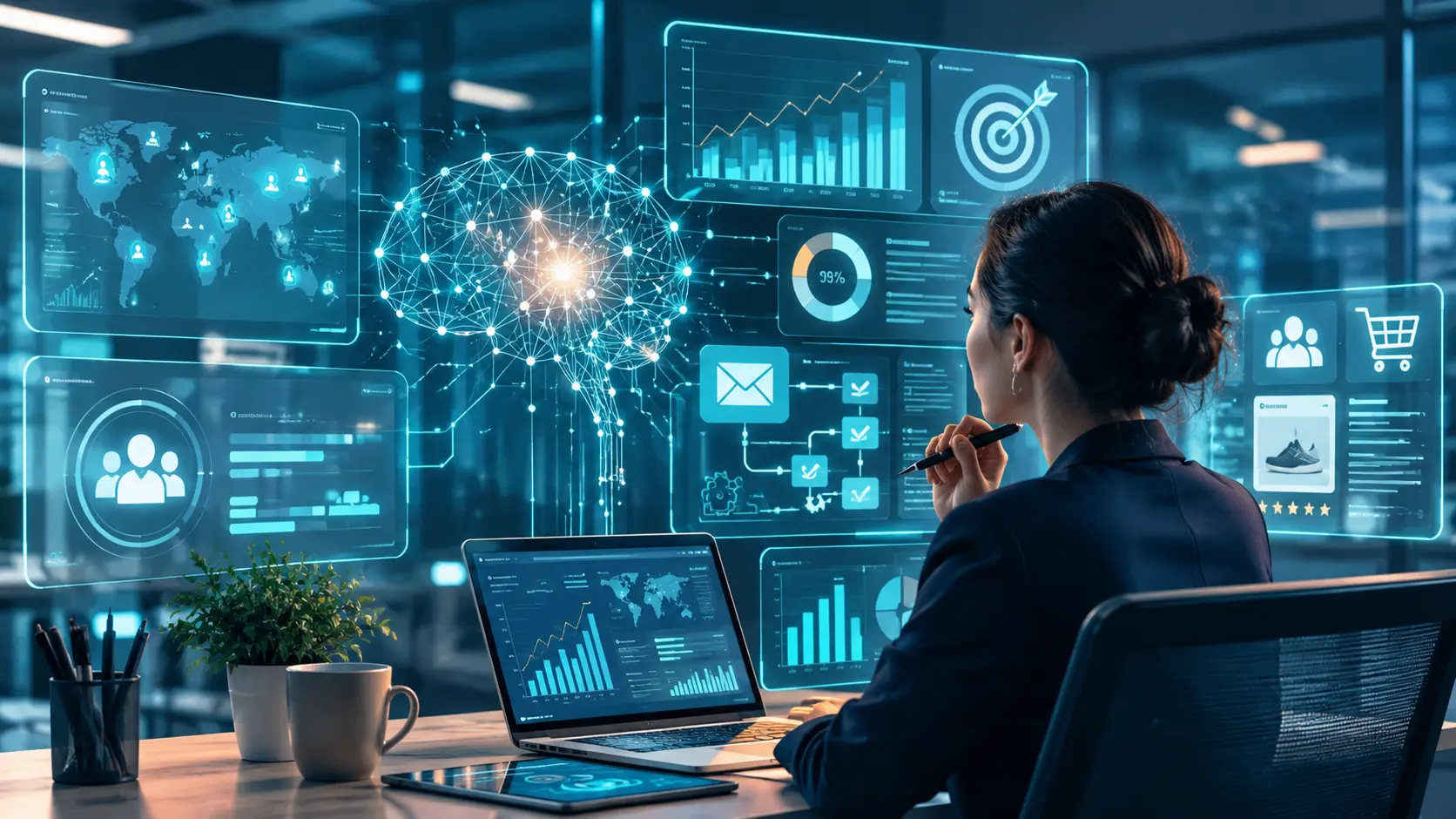
AI & Machine Learning in Marketing: Smarter Strategies for Better Business Growth
Slug: ai-machine-learning-marketing
Artificial Intelligence (AI) and Machine Learning (ML) have evolved from emerging technologies into essential tools for modern businesses. From predicting customer behaviour to automating repetitive marketing tasks, AI is transforming how organisations connect with customers, analyse data, and improve campaign performance.
Rather than replacing marketers, AI empowers teams to make faster, more informed decisions while delivering highly personalised customer experiences. Businesses that embrace AI-driven marketing gain a competitive advantage through better efficiency, improved customer insights, and measurable return on investment.
At DataOT, we help businesses leverage data, automation, and intelligent marketing strategies to improve decision-making and accelerate growth. As AI technologies continue to mature, organisations that integrate them into their marketing strategy will be better positioned for long-term success.
Understanding AI and Machine Learning
Although often used interchangeably, Artificial Intelligence and Machine Learning are different concepts.
Artificial Intelligence refers to computer systems designed to perform tasks that normally require human intelligence, including problem-solving, language processing, image recognition, and decision-making.
Machine Learning is a subset of AI that enables systems to learn from historical data and continuously improve their performance without being explicitly programmed for every scenario.
For marketers, this means software can identify customer trends, predict purchasing behaviour, optimise advertising campaigns, and generate actionable recommendations based on real-world data.
Instead of relying solely on intuition, businesses can make data-driven decisions with greater confidence.
AI-Powered Marketing Tools
One of the biggest advantages of AI is its ability to automate time-consuming marketing activities while improving campaign performance.
Today's AI-powered marketing platforms can assist with:
- Customer segmentation
- Email marketing automation
- Social media scheduling
- Personalised product recommendations
- Chatbots and customer support
- Lead scoring
- Campaign performance analysis
- Content generation assistance
Rather than manually analysing thousands of customer interactions, AI tools identify patterns within seconds, allowing marketing teams to focus on strategy instead of repetitive administration.
For businesses with limited marketing resources, AI provides enterprise-level capabilities without requiring large teams.
Predictive Analytics: Making Better Business Decisions
Predictive analytics is one of the most valuable applications of Machine Learning in marketing.
By analysing historical customer data, purchasing behaviour, website interactions, and engagement metrics, predictive models estimate future outcomes with impressive accuracy.
Businesses can use predictive analytics to:
- Forecast future sales
- Identify customers likely to purchase
- Predict customer churn
- Recommend products based on browsing history
- Estimate campaign performance
- Prioritise high-value leads
Instead of reacting after opportunities have passed, businesses can proactively target the right audience at the right time.
For example, an online retailer may discover that customers who purchase one product are highly likely to purchase complementary items within two weeks. AI identifies these opportunities automatically, allowing personalised follow-up campaigns that significantly increase revenue.
Automated Marketing Optimisation
Marketing optimisation traditionally required constant manual adjustments.
Teams would review campaign reports, modify budgets, test advertisements, adjust keywords, and monitor performance over many weeks.
AI dramatically shortens this process.
Modern advertising platforms use machine learning algorithms to automatically optimise:
- Google Ads bidding
- Social media advertising
- Budget allocation
- Audience targeting
- Ad placements
- Conversion optimisation
These systems continuously learn which audiences convert most effectively and adjust campaigns accordingly.
Instead of making monthly improvements, AI can make thousands of optimisation decisions every day.
The result is better campaign performance with reduced manual effort.
Personalisation at Scale
Consumers increasingly expect personalised experiences.
Generic marketing messages no longer achieve the same engagement levels as content tailored to individual interests and behaviours.
AI enables businesses to deliver highly personalised experiences across multiple channels.
Examples include:
- Personalised website content
- Product recommendations
- Dynamic email campaigns
- Individual customer offers
- Behaviour-triggered messaging
- Personalised search results
Streaming platforms, online retailers, and financial institutions already rely heavily on AI-driven personalisation.
Businesses of every size can now implement similar strategies using modern marketing technology.
Personalisation not only improves customer satisfaction but also increases conversion rates, customer loyalty, and lifetime value.
AI's Role in Content Strategy
Content remains one of the most important aspects of digital marketing, but developing consistent, high-quality content requires significant time and resources.
AI is changing how businesses approach content planning, creation, and optimisation.
Rather than replacing human creativity, AI supports content teams by helping with:
- Topic research
- Keyword analysis
- Content briefs
- SEO recommendations
- Headline generation
- Content clustering
- Performance forecasting
- Content gap analysis
AI can also analyse competitors to identify opportunities where businesses can create more valuable, relevant content.
Marketers still provide strategic direction, brand voice, and editorial oversight, while AI accelerates research and improves efficiency.
This collaboration enables organisations to publish higher-quality content more consistently.
Smarter Customer Insights
Every customer interaction generates valuable data.
Website visits, email opens, purchases, downloads, enquiries, and social media engagement all contribute to understanding customer behaviour.
AI processes these vast datasets far more effectively than manual analysis.
Businesses gain deeper insights into:
- Customer preferences
- Buying behaviour
- Seasonal trends
- Marketing attribution
- Customer lifetime value
- Audience segmentation
These insights enable businesses to allocate marketing budgets more effectively while improving overall customer experience.
Rather than relying on assumptions, decisions become evidence-based.
Enhancing Marketing ROI
Marketing budgets must demonstrate measurable value.
AI improves return on investment by helping businesses:
- Reduce wasted advertising spend
- Improve targeting accuracy
- Increase conversion rates
- Identify profitable customer segments
- Improve customer retention
- Optimise campaign timing
Because AI continuously learns from campaign performance, marketing becomes increasingly efficient over time.
Small improvements across multiple campaigns often generate significant long-term financial benefits.
Responsible Use of AI
While AI offers substantial opportunities, businesses should also adopt responsible governance.
Successful AI implementation includes:
- Protecting customer privacy
- Maintaining data quality
- Monitoring algorithm performance
- Avoiding biased datasets
- Ensuring transparency
- Keeping human oversight for strategic decisions
AI should support informed decision-making rather than replacing critical business judgement.
Organisations that combine intelligent automation with experienced professionals achieve the strongest outcomes.
Preparing for the Future
AI and Machine Learning will continue to reshape marketing as technology advances.
Emerging capabilities such as predictive customer journeys, conversational AI, advanced automation, and real-time decision engines will become increasingly accessible to businesses of all sizes.
Companies that invest in quality data, analytics infrastructure, and AI-ready marketing strategies today will be better positioned to adapt as customer expectations evolve.
The future belongs to organisations that combine technology with strategic thinking.
Partner with DataOT
Implementing AI successfully requires more than simply adopting new software. It requires clean data, effective analytics, thoughtful strategy, and ongoing optimisation.
At DataOT, we help businesses harness data, automation, and intelligent marketing solutions to improve performance and make better business decisions. Whether you're looking to optimise campaigns, implement predictive analytics, or build a smarter digital strategy, our team can help you unlock the full potential of AI-driven marketing.
Learn more about our services by visiting https://www.dataot.com/ and discover how intelligent data solutions can support your business growth.


